Settlement without Restitution or Justice.

Goldman Sachs has just settled with the Federal Housing and Finance Agency (FHFA) to the tune of a cool 3.15 BILLION dollars! This comes on the heels of multi-billion dollar settlements between the Federal Government and other giants of the banking industry. The settlement will certainly cut into Goldman’s profits, which in 2013, were just over 8 billion.

Now, here’s a tiny bit more context. Goldman is the largest broker of hedge fund activity in the world. They provide the very largest hedge funds (nearly 20% of the entire industry) with services such as financing, trading and holding assets. Last year, the top hedge fund manager’s personal compensation was 4 BILLION dollars. The second highest, an ex-Goldman employee, was 3.5 billion. In other words, the financial industry regularly sees ANNUAL individual compensations meeting and exceeding the fines being paid by entire institutions.

And because the government has systematically chosen to settle (the bar for conviction is perversely high), none of these agents of the 2008 financial crash have to admit wrong-doing. While conviction may not be in the cards, the process of a trial would surely have revealed more than a few unpleasantries. So they settle. Again and again. (If you follow these patterns into how corporations behave with one another, settlement has allowed for large scale collusion by pharmaceutical and patent industry giants, amongst others. Weakened regulators try and keep up. When they give up, they are systematically hired by the industries they were once charged with regulating.)

These corporations have become settlers of a different sort. And they colonize from within. As we leave behind settler colonialism and enter into an era of settlement capitalism, we can begin to glean some of the symptoms of the autocolonial turn. If the British perfected the practice of divide and conquer during their Empire, note how the same principle has devastated the institutions of liberal democracy in the United States.

Here’s an amazing fucking sentence.

…in a talk loaded with one after another. The astonishingly brilliant Lauren Berlant at AAA in 2011: http://supervalentthought.files.wordpress.com/2011/12/berlant-aaa-2011final.pdf

“Austerity, Precarity, Awkwardness”

“But fantasy can’t be garbaged in the same way that governmental infrastructures have been: for the state’s legitimacy to continue appearing sovereign and performative, the state finds it still imperative for citizens and denizens not only to appear to consent to the law, the police, and the tax code, but also to harbor the sentimental collective memories of suffering and optimism that maintain the fantasy of the common that still floats the nation form’s promise, even as its material presence, sold off to the highest private bidders, disappoints, defunds, and deserts the mass of the people who rely on it.”

The Walmart WMD

SpecialReport_0419_MillerBombInfo_480x360

Charging this kid with using a Weapon of Mass Destruction invites blowback. (And we should take note of the tortuous legal definitions and history of the deliberately ill-defined concept of WMD’s.)  In what ways are such acts of classification and naming NOT an invitation to escalate? Does this not give incentive to malcontents, whatever their background or intent? Now you too can be on the same footing as a Saddam Hussein or, more recently, a Bashar al-Assad.

This charge of using a WMD strikes me not as threat prevention but, rather, as threat propagation. And, in this sense, charging a 19 year old boy for making a WMD with ingredients that could be bought at any Walmart is a fitting and consistent continuation of this pattern, where militaristic escalation drives both a ‘war on terror,’ as well as defending the security of a ‘homeland.’

PRIVATE

Chronicle of a Species Foretold.

The real anonymous lies in the inchoate interstices between capital, commerce, legislation and governance. It is the accretion of oligarchic action. Those places, despite all designs towards transparency in late liberalism, are of -ahem- lively forms of unknowing, of secreting away the conditions of our own being. These actions, of course, effectively position us into a condition of living an ‘unreal.’*

*And we wonder why this obsession with ‘un’ reality; augmented, alternate, multiple, etc. We are living something that is increasingly unknown to us, despite all of the innovations and refinements of technoculture–rather, it is unreal BECAUSE of these refinements. The late liberal human is dissolving. This is necrosis. The species becomes something else as it dies off.

Years go by. I wish I could remember. But it is so very hard to not be anew.

We all knew it was going to happen. Chronicle of a war foretold. I hope, during this anniversary, the press will be willing to rigorously cover themselves. But the American ‘press’ has a malicious habit of almost never doing so. Which is why we need comedians, I guess. They do the (media) criticism that the press, or politicians, or corporations systematically try not to do. (The irony of being able to capitalize on outrage as part of the information-entertainment complex is not lost on many of us.) It’s not that such criticisms don’t exist in the public sphere. Rather, they just don’t exist for very long. They are never the stories upon which we can dwell, contemplate, think. None of the aforementioned institutions can soundly or ethically examine their own underlying structures. They exist as phantasms of their own doing, their hidden underbellies are always to be protected.*

And why would such institutions examine the basis for their own being, their wealth, their profit? Their hold on power relies upon one another. They exist for one another. Their animating  competition is a myth to which we are all told to subscribe. And that is planetary. And that is neoliberal capitalism. And that is why the United States is not really a  a democracy. After 9/11, we accelerated the colonization of ourselves. And, yet, this may be a very good thing. Depending, of course, on how you look at it.

*They pay fines of various sorts to absolve themselves of their own corruption. Guilt never has to be admitted. Not the first time in history this has ever happened.  And as (if?) the species goes forward, probably not the last. We will all, of course, pay for these sins.  The act of writing is obscure in the face of such power. So am I. But the obscurity of billions may still have value.

Can Transparency defend against Invisibility?: Secrecy, Openness and the State of Social Media

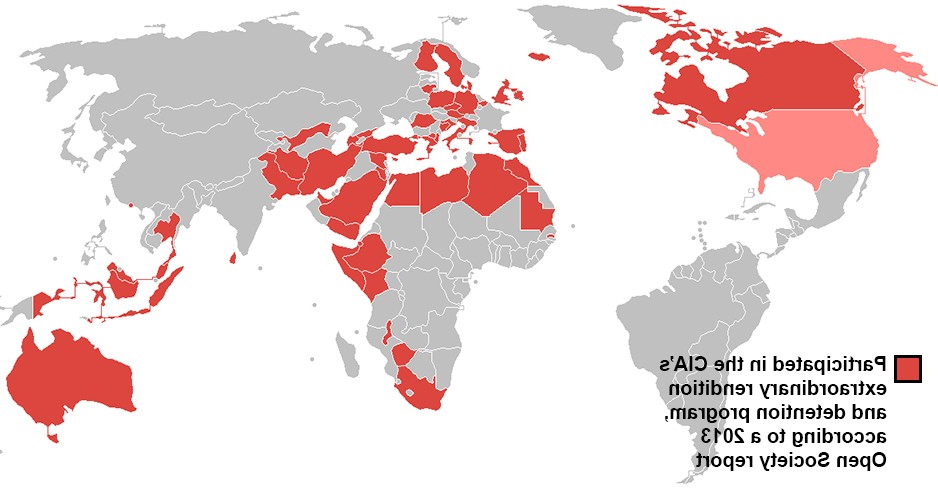
Rendition Map

In 2004, just as the rise of Web 2.0 ushered in a new wave of techno-utopianism, historian of science Peter Galison sketched out some rough calculations in an attempt to gauge the size of the so-called ‘classified’ universe. His conclusion: “Whether one figures by acquisition rate, by holding size, or by contributors, the classified universe is, as best I can estimate, on the order of five to ten times larger than the open literature that finds its way to our libraries” (“Removing Knowledge” 231). It would be more than a year later that The New York Times would reveal to the public that such secrecy had extended deep into the nation’s commercial telecommunications networks.

Nearly a decade since then, how have various campaigns that marshal the language and rhetoric of openness and transparency responded to the fact that we are dealing with information as structural absence? In what ways have different types of social and p2p media accounted for and responded to these facets of the so-called ‘public sphere,’ particularly as digital media proliferates exponentially? Is the rise of secrecy inextricably intertwined with the rise of digital networks? And how might we better register this seeming paradox when we rely upon digital media to define access and openness, when these technologies often arise from an inaccessible universe of government and corporate secrecy–a thicket of Non-Disclosure Agreements and Classification Actions?