Category: autocolonialism
MLA 2027 Special Session Proposal–Tales of the Late Human: Is this what extinction feels like?
The following is a Special Session Proposal for the 2027 Modern Language Convention to be held January 7-10 in Los Angeles, California.
What does it mean to survive under late capitalism—and for whom does survival remain possible? This panel takes extinction not as a future horizon but as a present condition: a slow, stratified process already embedded in economic structures, urban environments, and narrative form. Bringing together and bridging work from literary and cultural studies, earth system science, and science and technology studies, the three presentations gathered here examine how capitalism operates simultaneously as an economic system and an extinction-producing apparatus—one that reorganizes ecological life, human subjectivity, and the boundaries of the human itself.
The panel opens with Amit Ray’s analysis of what he terms the extinction economy: the self-accelerating circuit by which platform capitalism hastens ecological breakdown while simultaneously monetizing the crises it generates. Ray’s concept of autocolonialism—the internalized reproduction of extractive structures—provides a diagnostic for understanding why populations consent to technological “fixes” that deepen the conditions requiring rescue. Drawing on Disaster Capitalism and the Capitalocene, Ray argues that ecological collapse does not interrupt late-stage economic logic but intensifies it. As Michel Nieva’s Technology and Barbarism illuminates, this is barbarism wearing the face of innovation—techno-solutionism functioning as a civilizational alibi for annihilation, in which populations consent to extractive fixes that reproduce the very crises they claim to resolve. Silicon Valley’s Mars colonization fantasies represent the logical endpoint—capital exporting terrestrial collapse rather than confronting it. Crucially, Ray insists this is also a biopolitical failure: the racialized and classed distribution of survivability ensures that the costs of ecological collapse are borne by those least responsible for generating it.
Sean T. Hammond extends and complicates this framework by introducing the nonhuman as both case study and mirror. Where Ray locates the extractive logic in venture capital and techno-solutionism, Hammond finds it embedded in the built environment itself. His analysis of synanthropic domestication—traced through urban raccoon populations exhibiting measurable morphological shifts consistent with early domestication—argues that cities function as selection machines, structurally breeding compliance across generations. The raccoon’s self-selection into the “trash economy” illuminates what capitalism’s logic demands of any species that seeks proximity to it. Hammond’s reach back to the Epic of Gilgamesh as the earliest literary recognition of civilization’s domesticating violence places Ray’s extinction economy in deep historical context: the one-way transformation that begins with eating the bread and ends with a population adapted to conditions their ancestors would have found unlivable.
Christene d’Anca’s paper draws the literary and theoretical threads of the panel into its sharpest focus. Reading Cormac McCarthy’s The Road and Octavia E. Butler’s Parable of the Sower through Lauren Berlant’s concept of “slow death,” Achille Mbembe’s necropolitics, and Marx’s metabolic rift, d’Anca argues that contemporary fiction registers extinction as an aesthetics of abandonment—a narrative form in which the exhaustion of humanist assumptions about agency and progress becomes visible. Where Ray identifies the structural drivers of biopolitical abandonment and Hammond traces their embodied and evolutionary effects, d’Anca asks how that abandonment is lived and narrated: not as apocalyptic rupture but as the ongoing normalization of attrition. Butler’s speculative vision foregrounds adaptive subjectivities that emerge within systemic collapse, while McCarthy’s ashen landscape registers its absolute foreclosure of futurity—together staging the full range of end-times subjectivity the panel sets out to examine.
Alongside one another, these three presentations construct a layered account of extinction subjectivity under late capitalism. Ray diagnoses the economic logic; Hammond maps its embodied and evolutionary effects on bodies—human and nonhuman alike; d’Anca examines how that logic shapes narrative consciousness and the literature of survival. Across all three, a shared question emerges: if capitalism has rendered extinction profitable, compliance adaptive, and abandonment livable, what forms of critique, imagination, or refusal remain available? This panel does not offer easy answers but insists that confronting them requires exactly the kind of interdisciplinary exchange—between ecology, political economy, and literary form—that these presentations, in dialogue, make possible.

Injured Buddha ©2008 Banksy
Hybrid note to E and T
Capitalism and War unleash human biology in recombinant and hybrid ways. In this sense the human begins to actively restructure itself. And, militaries and companies are the ones that are exploring such processes most intensively. Such invisibility begets all kinds of trauma, deformation, and amnesia-cal qualities in a species toto. It boggles my mind. This is happening. Much has likely already happened. The big nation states have only ever been war machines, no?
And corporations eased themselves into alignment over much of the last century. Corpor-national phenomena.
They are our militarily industrialized complexities, within which secrecy abounds
This evacuates and exhausts me. I suspect it exhausts those within and outside what we might consider to be the spectrum between secrecy and propriety. Secrets of trade and otherwise.
Our missing cores, our absent presences.
We, as a species, are dangerous. And we are self-destructing.
And its as if there is nothing we can do…this is what we are made of. This is the tissue, the latticework of ages. These last remnants of (en-machinated) language.
These gasps, if you will. #languageisleavingus
I repeat: This is a species that will be content to self-destruct, given it was functionally built upon machines of war, first and foremost. As we extend into the nucleus of not just the atom, but of the cell. As mere decades pass. (And to think we’re still here.)
I don’t want to be a part of it, for the most part. But here we are. This is what extinction feels like. And we are doing it to ourselves. #autocolonialism
Capitalism and War unleash human biology in recombinant and hybrid ways. This happens not in decades, but in years. #talesofthelatehuman
We are bound for it to be this way. We lead with our own complicity in all of it. This is the human, of late.
We are the extinction event.
(Make of this word and brain salad what you will. Words fail me.)
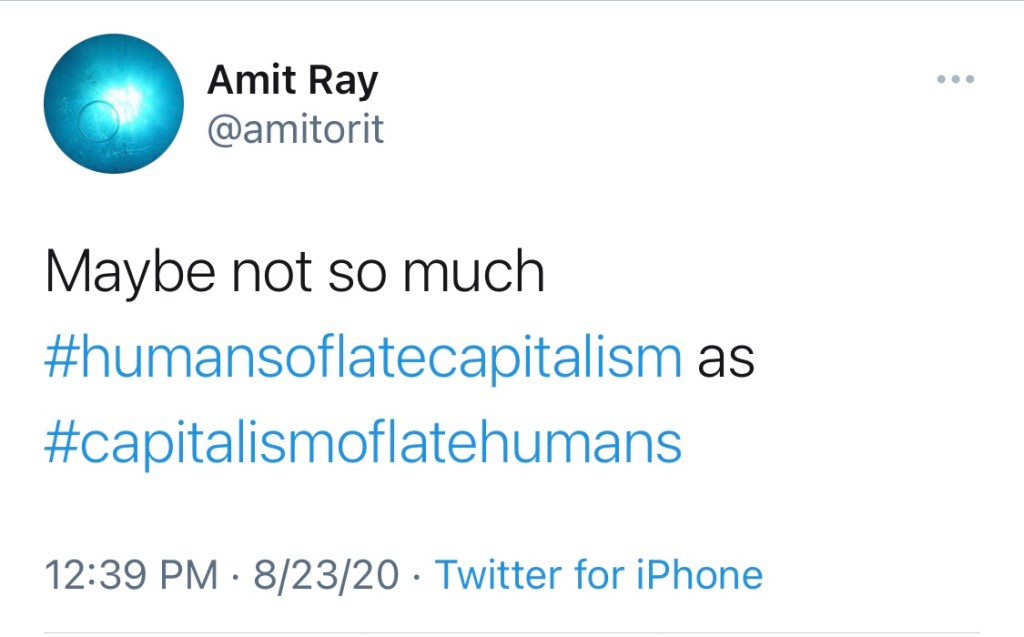
Capitalism of late humans
Note to A and E, 3/12/20
A thought. Please indulge me.
CRISPR is derived from a bacterial mechanism that provides immunity from viruses by using RNA to cut and paste snippets of the viral attacker into the genetic code of the bacterium itself.
There are large scale endeavors to use genetic editing strategies to engineer responses to actual viruses. The arguments for expediency and exigency abound.
That these things come into our knowledge and come into technoscientific existence so quickly —seemingly all at once—- makes my brain hurt.
This is all happening so fast, my friends. Much of it in less than a decade. And even that short time scale seems to be compacting upon itself.
PostScript Sat March 15
But what we never seem to understand is that just because we have power doesn’t mean we are in control. Which, I am convinced, speeds up the process of humans attempting to colonize, cum synthesize, cum automate their individual AND aggregate activities. Whether we can admit it or not, synthetic biology is already here. A crisis like this will only expedite acknowledging the transformation of current and subsequent Homo sapiens genetics, before, during and after “expression.”
A species expands asymptotically, no longer what it thought it was, unbecoming in media res.
Or so I tell myself. #talesofthelatehuman
Naked news, fake-d news, or “something else entirely”?
“Was a story selected for its statistical prominence among news organs, or because a personalization algorithm picked it out for us? If the selection was based on statistics, then which statistics—the number of mentions of the story, the authority of the news outlets promoting it, or something else entirely?” Frank Pasquale, The Black Box Society (2015)
I’m thinking, erm, something else entirely. #agnotology #talesofthelatehuman
Gone. Forgotten.
Upgrade, feverish
Newness begets what we have found: nothingness. We could never be present in such expectations of a future, predicated upon nearly instantaneous forms of obsolescence.
The past and future enfold upon this non-existent now; a now which is forgetting, forgotten. Gone. Absent: Present. The late human sleepsasleep, wakesawake, shuns extinct, shuns.
We thought we were human as we consciously passed the ghost of ourselves onwards.
Past, psst, passed. Life.
#talesofthelatehuman
Thoughts for my friend, Jeremy W.

©Shaun Tan
Those who have power have no interest in giving it up. But they are not in control. They are the most precarious of us all.
Anॐinous. Us.
These Borgesian politics. These machines in which we find ourselves. These networks, and the subjects they produce. This singularity, it seems, is singularly circular. All these changes, never changing.
Secrets of Trade, Secrets of State, and the Autocolonial Turn
Ten years ago, I read an essay in Critical Inquiry entitled “Removing Knowledge.” In it, Peter Galison, an eminent historian of science and nuclear physicist (since for old guard historians of science, you had to be the latter to be the former) tries to make an educated guess about the scope of secrecy in our present day society–USA circa 2003, 2004. What he manages to convey, with a wink and a nod, is this: what the state makes private through secrecy is what corporations make private through intellectual property. And that for the last few decades, the state has LOOKED TO THE CORPORATIONS to establish legal precedent for this power.

I still don’t know which of these entities is more powerful-corporations or nation-states. Or perhaps we’ve invented a whole new category, the corpor-nation (pun away you clowns.) Corporate inversions are happening everywhere, but they are particularly powerful in this American center of power. And a corporeal inversion occurred a few years ago, as we united citizens may or may not have registered. I mark that moment as a poignant reminder of the self-destruction of these economic and political liberalisms and, more than likely, of the ‘democracies’ such liberalisms have conceived.
I will be using this article in the Fall to begin a discussion about openness. And more importantly, I think, I am using this piece to address closed-ness. Because the ways in which things are closed off are increasingly unlikely to be accessible in and by any kind of public until long after significant decisions–whether they be statecraft, or marketcraft–have already been made. Some will say this is the way it has always been. I don’t know, and can’t know, one way or the other. And this I lament. Sigh.
Settlement without Restitution or Justice.
Goldman Sachs has just settled with the Federal Housing and Finance Agency (FHFA) to the tune of a cool 3.15 BILLION dollars! This comes on the heels of multi-billion dollar settlements between the Federal Government and other giants of the banking industry. The settlement will certainly cut into Goldman’s profits, which in 2013, were just over 8 billion.
Now, here’s a tiny bit more context. Goldman is the largest broker of hedge fund activity in the world. They provide the very largest hedge funds (nearly 20% of the entire industry) with services such as financing, trading and holding assets. Last year, the top hedge fund manager’s personal compensation was 4 BILLION dollars. The second highest, an ex-Goldman employee, was 3.5 billion. In other words, the financial industry regularly sees ANNUAL individual compensations meeting and exceeding the fines being paid by entire institutions.
And because the government has systematically chosen to settle (the bar for conviction is perversely high), none of these agents of the 2008 financial crash have to admit wrong-doing. While conviction may not be in the cards, the process of a trial would surely have revealed more than a few unpleasantries. So they settle. Again and again. (If you follow these patterns into how corporations behave with one another, settlement has allowed for large scale collusion by pharmaceutical and patent industry giants, amongst others. Weakened regulators try and keep up. When they give up, they are systematically hired by the industries they were once charged with regulating.)
These corporations have become settlers of a different sort. And they colonize from within. As we leave behind settler colonialism and enter into an era of settlement capitalism, we can begin to glean some of the symptoms of the autocolonial turn. If the British perfected the practice of divide and conquer during their Empire, note how the same principle has devastated the institutions of liberal democracy in the United States.
 Anominous.us