Category: extinction
MLA 2027 Special Session Proposal–Tales of the Late Human: Extinction, Disposability, and the End-Times Subject
The following is a Special Session Proposal for the 2027 Modern Language Convention to be held January 7-10 in Los Angeles, California.
What does it mean to survive under late capitalism—and for whom does survival remain possible? This panel takes extinction not as a future horizon but as a present condition: a slow, stratified process already embedded in economic structures, urban environments, and narrative form. Bringing together and bridging work from literary and cultural studies, earth system science, and science and technology studies, the three presentations gathered here examine how capitalism operates simultaneously as an economic system and an extinction-producing apparatus—one that reorganizes ecological life, human subjectivity, and the boundaries of the human itself.
The panel opens with Amit Ray’s analysis of what he terms the extinction economy: the self-accelerating circuit by which platform capitalism hastens ecological breakdown while simultaneously monetizing the crises it generates. Ray’s concept of autocolonialism—the internalized reproduction of extractive structures—provides a diagnostic for understanding why populations consent to technological “fixes” that deepen the conditions requiring rescue. Drawing on Disaster Capitalism and the Capitalocene, Ray argues that ecological collapse does not interrupt late-stage economic logic but intensifies it. As Michel Nieva’s Technology and Barbarism illuminates, this is barbarism wearing the face of innovation—techno-solutionism functioning as a civilizational alibi for annihilation, in which populations consent to extractive fixes that reproduce the very crises they claim to resolve. Silicon Valley’s Mars colonization fantasies represent the logical endpoint—capital exporting terrestrial collapse rather than confronting it. Crucially, Ray insists this is also a biopolitical failure: the racialized and classed distribution of survivability ensures that the costs of ecological collapse are borne by those least responsible for generating it.
Sean T. Hammond extends and complicates this framework by introducing the nonhuman as both case study and mirror. Where Ray locates the extractive logic in venture capital and techno-solutionism, Hammond finds it embedded in the built environment itself. His analysis of synanthropic domestication—traced through urban raccoon populations exhibiting measurable morphological shifts consistent with early domestication—argues that cities function as selection machines, structurally breeding compliance across generations. The raccoon’s self-selection into the “trash economy” illuminates what capitalism’s logic demands of any species that seeks proximity to it. Hammond’s reach back to the Epic of Gilgamesh as the earliest literary recognition of civilization’s domesticating violence places Ray’s extinction economy in deep historical context: the one-way transformation that begins with eating the bread and ends with a population adapted to conditions their ancestors would have found unlivable.
Christene d’Anca’s paper draws the literary and theoretical threads of the panel into its sharpest focus. Reading Cormac McCarthy’s The Road and Octavia E. Butler’s Parable of the Sower through Lauren Berlant’s concept of “slow death,” Achille Mbembe’s necropolitics, and Marx’s metabolic rift, d’Anca argues that contemporary fiction registers extinction as an aesthetics of abandonment—a narrative form in which the exhaustion of humanist assumptions about agency and progress becomes visible. Where Ray identifies the structural drivers of biopolitical abandonment and Hammond traces their embodied and evolutionary effects, d’Anca asks how that abandonment is lived and narrated: not as apocalyptic rupture but as the ongoing normalization of attrition. Butler’s speculative vision foregrounds adaptive subjectivities that emerge within systemic collapse, while McCarthy’s ashen landscape registers its absolute foreclosure of futurity—together staging the full range of end-times subjectivity the panel sets out to examine.
Alongside one another, these three presentations construct a layered account of extinction subjectivity under late capitalism. Ray diagnoses the economic logic; Hammond maps its embodied and evolutionary effects on bodies—human and nonhuman alike; d’Anca examines how that logic shapes narrative consciousness and the literature of survival. Across all three, a shared question emerges: if capitalism has rendered extinction profitable, compliance adaptive, and abandonment livable, what forms of critique, imagination, or refusal remain available? This panel does not offer easy answers but insists that confronting them requires exactly the kind of interdisciplinary exchange—between ecology, political economy, and literary form—that these presentations, in dialogue, make possible.

Injured Buddha ©2008 Banksy
Call for Papers–Capitalism of Late Humans: Confronting Extinction (MLA 2027)
Deadline for Submissions: March 21, 2026
Organizer: Dr. Amit Ray/Rochester Institute of Technology
Contact: axrgsl at rit dot edu
This panel explores capitalism’s role in accelerating human extinction. How do late-stage economic systems shape ecological collapse, biopolitical abandonment, and end-times subjectivity? We welcome interdisciplinary work confronting survival, disposability, and the limits of the human. If accepted, this Special Session panel will convene during the 2027 Modern Language Association Conference in Los Angeles, January 7-10, 2027. Please send an abstract of 200-400 words to Dr. Amit Ray at axrgsl at rit dot edu no later than March 21, 2026.
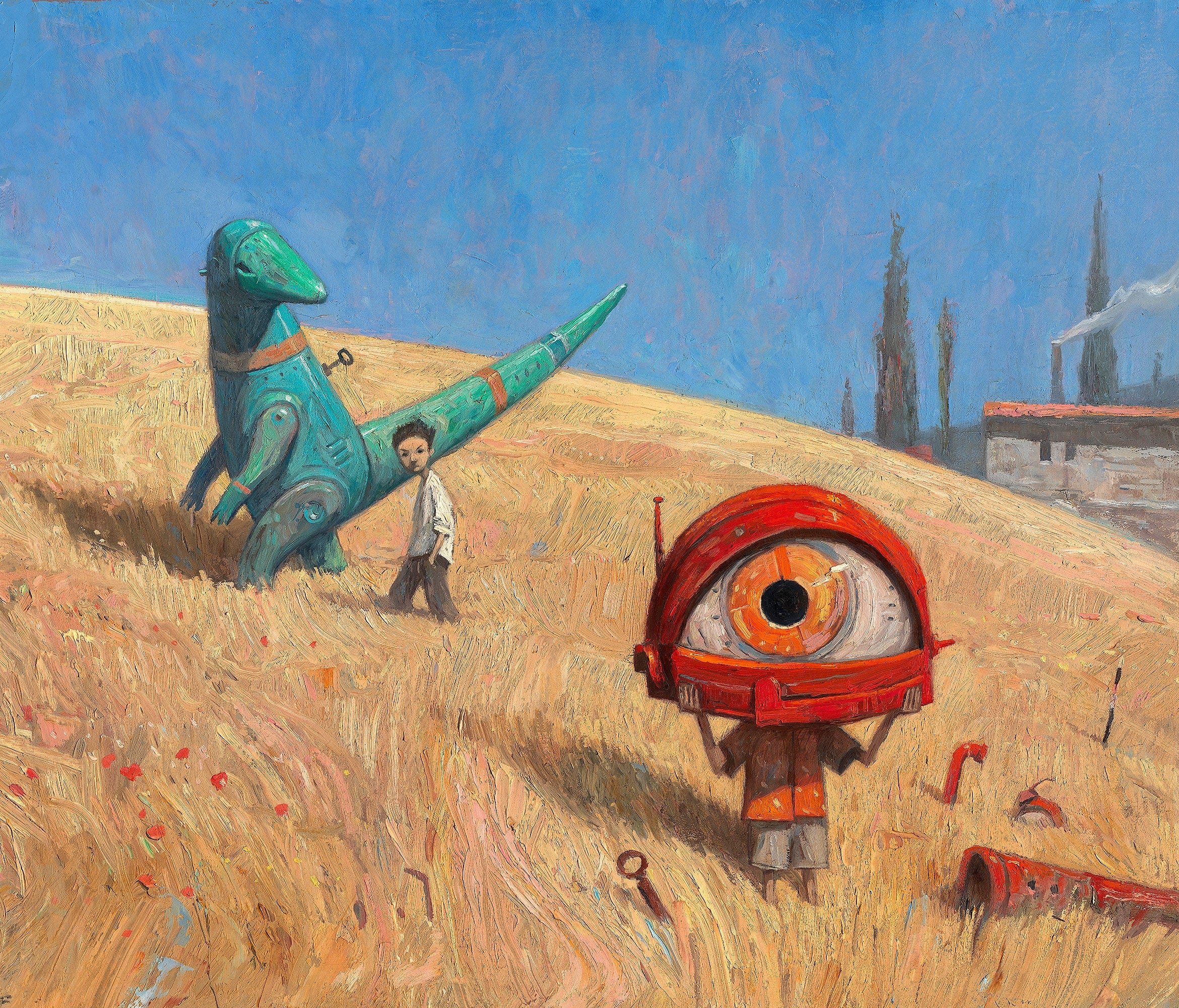
This is what extinction feels like.
A melting planet, an accelerating (accelerant) species. Hyper nationalism and ideological militancy… I mean what’s not to like about a species that toys with its own extinction, as it demands growth on every front that can be monetized and brought into financial logic? Our very extinction seems to be available for extraction and profit—a growth industry that ends in collapse. Ours is a species in bloom. #autocolonialism
Hybrid note to E and T
Capitalism and War unleash human biology in recombinant and hybrid ways. In this sense the human begins to actively restructure itself. And, militaries and companies are the ones that are exploring such processes most intensively. Such invisibility begets all kinds of trauma, deformation, and amnesia-cal qualities in a species toto. It boggles my mind. This is happening. Much has likely already happened. The big nation states have only ever been war machines, no?
And corporations eased themselves into alignment over much of the last century. Corpor-national phenomena.
They are our militarily industrialized complexities, within which secrecy abounds
This evacuates and exhausts me. I suspect it exhausts those within and outside what we might consider to be the spectrum between secrecy and propriety. Secrets of trade and otherwise.
Our missing cores, our absent presences.
We, as a species, are dangerous. And we are self-destructing.
And its as if there is nothing we can do…this is what we are made of. This is the tissue, the latticework of ages. These last remnants of (en-machinated) language.
These gasps, if you will. #languageisleavingus
I repeat: This is a species that will be content to self-destruct, given it was functionally built upon machines of war, first and foremost. As we extend into the nucleus of not just the atom, but of the cell. As mere decades pass. (And to think we’re still here.)
I don’t want to be a part of it, for the most part. But here we are. This is what extinction feels like. And we are doing it to ourselves. #autocolonialism
Capitalism and War unleash human biology in recombinant and hybrid ways. This happens not in decades, but in years. #talesofthelatehuman
We are bound for it to be this way. We lead with our own complicity in all of it. This is the human, of late.
We are the extinction event.
(Make of this word and brain salad what you will. Words fail me.)
Capitalism of late humans
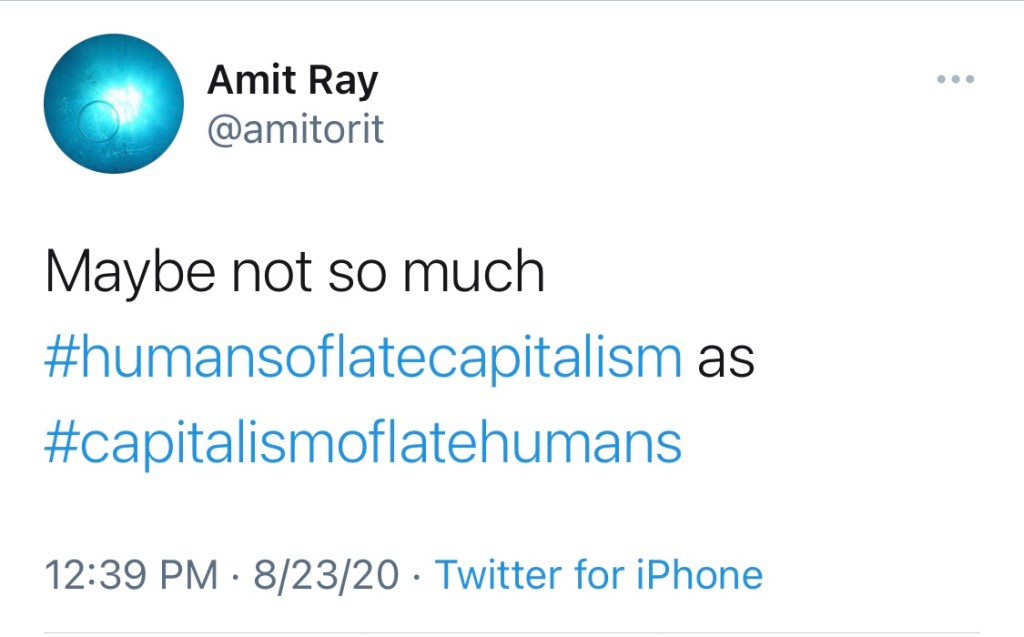
Note to A and E, 3/12/20
A thought. Please indulge me.
CRISPR is derived from a bacterial mechanism that provides immunity from viruses by using RNA to cut and paste snippets of the viral attacker into the genetic code of the bacterium itself.
There are large scale endeavors to use genetic editing strategies to engineer responses to actual viruses. The arguments for expediency and exigency abound.
That these things come into our knowledge and come into technoscientific existence so quickly —seemingly all at once—- makes my brain hurt.
This is all happening so fast, my friends. Much of it in less than a decade. And even that short time scale seems to be compacting upon itself.
PostScript Sat March 15
But what we never seem to understand is that just because we have power doesn’t mean we are in control. Which, I am convinced, speeds up the process of humans attempting to colonize, cum synthesize, cum automate their individual AND aggregate activities. Whether we can admit it or not, synthetic biology is already here. A crisis like this will only expedite acknowledging the transformation of current and subsequent Homo sapiens genetics, before, during and after “expression.”
A species expands asymptotically, no longer what it thought it was, unbecoming in media res.
Or so I tell myself. #talesofthelatehuman
AcceleRants
Accelerators and accelerants, recombinant and chaotic. Synthetic life emerges from this bacterial animal which, having colonized everything, learns to colonize anew. It grows, it devours, it blooms, it dies. But not without giving birth to other forms of life, intentionally and otherwise. The Xenobots arrive.
 Anominous.us